
Freenow's Ireland corporate mobility report for 2026
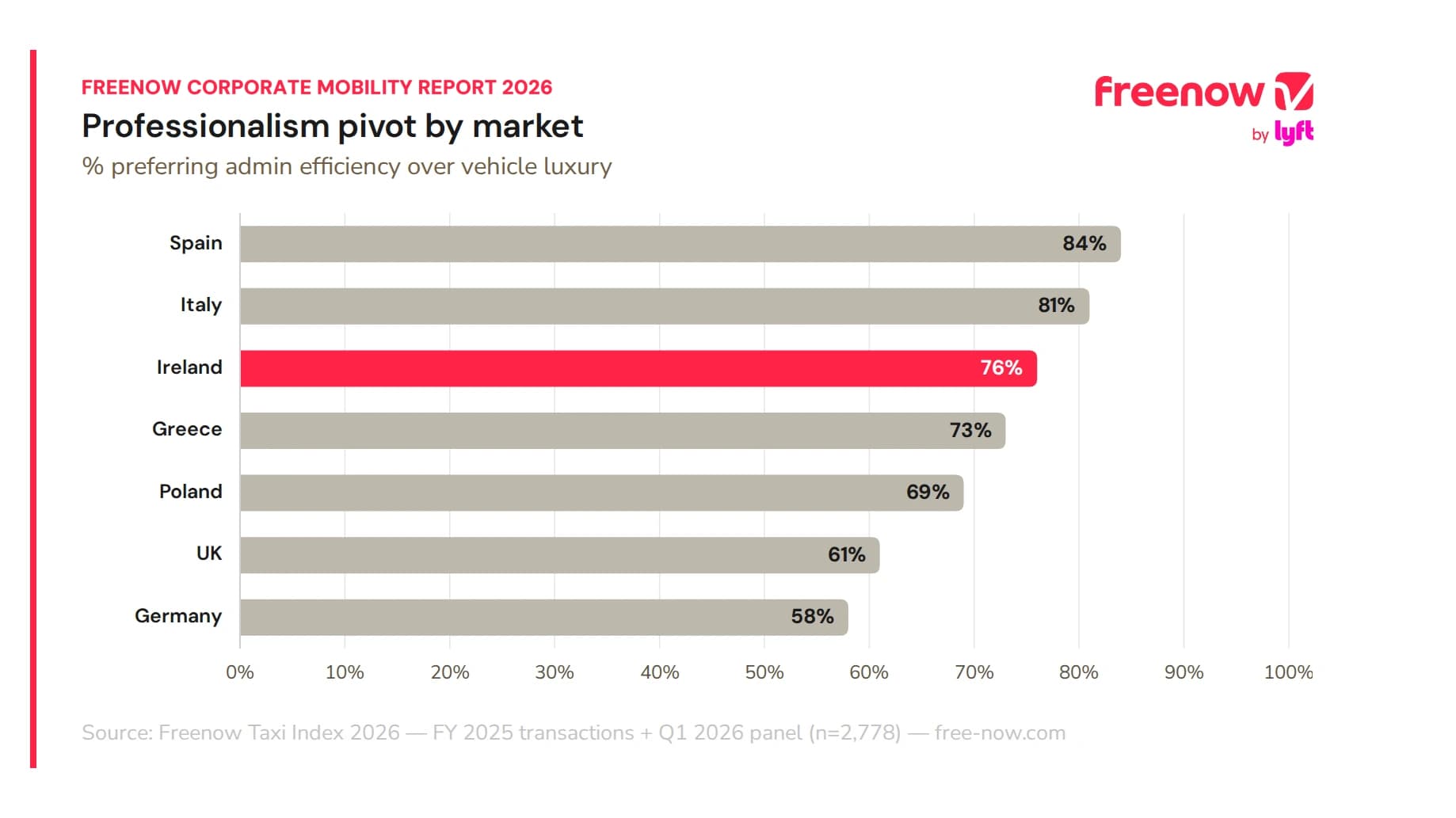
According to Freenow by Lyft's 2026 corporate mobility report for Ireland, 76% of Irish business travellers define a professional service through automated administration and seamless digital expensing rather than vehicle class or a uniformed driver.

Key findings
76% of Irish business travellers rate automated administration and smooth digital expense management as the primary definition of professionalism (internal panel, Q1 2026, n=351 in Dublin), ranking Ireland third among all seven European markets analysed.
62% of all rides on Freenow's platform in Ireland are electrified, establishing the highest overall platform electrification share of any market in this report.
26.6% of all users in Ireland know Freenow for Business, the highest level across Europe, rising to 31.8% among hybrid business-and-leisure users
10.3% B2B profile share and 5.17 monthly rides per corporate user position Dublin as the clear leader in business mobility intensity among all Irish cities in FY 2025.
33% higher loyalty distinguishes B2B users over B2C users platform-wide.
Business travellers average 3.44 rides per month compared to 2.73 for private passengers.
What is the Freenow corporate mobility report for Ireland?
The Freenow corporate mobility report for Ireland 2026 is an industry research study published by Freenow to establish verified operational benchmarks across European urban mobility and corporate travel. The study examines how modern business travel patterns evolve, assessing administrative efficiency, fleet sustainability adoption and service reliability for corporate travel managers. This Ireland-focused edition analyses four key commercial centres: Dublin, Cork, Galway and Limerick.
The research framework employs a three-tiered triangulation model approved by internal compliance and data protection teams, ensuring no personally identifiable information is used. First, an external Brand Tracker panel collected responses from approximately 300 Irish participants per quarter between Q1 2025 and Q1 2026. Second, an internal panel survey conducted via Qualtrics and distributed through CRM channels gathered 351 verified responses in Q1 2026, focusing specifically on Dublin. Third, aggregated transactional data covering the complete 2025 financial year captures operational activity for corporate and hybrid travel across Dublin, Cork, Galway and Limerick, with the latter three hubs analysed exclusively through transactional metrics.
What do Irish business travellers consider a professional service?
76% of Irish business travellers define a professional journey through automated administrative workflows rather than vehicle class or a uniformed driver (internal panel, Q1 2026, n=351), ranking Ireland third across all seven European markets analysed.
Safety and service reliability represent the two foremost selection criteria for corporate mobility in Ireland, scoring 5.1 and 5.6 respectively on an importance scale from 1 to 10.
37 years old is the average age of an Irish corporate user, reflecting a younger user demographic compared with typical European benchmarks.
74% of corporate users in Ireland belong to Millennial (50%) or Generation Z (24%) cohorts, establishing a digitally native base that prioritises mobile automation.
For Irish business travellers, the benchmark of professionalism in corporate mobility has fundamentally shifted away from vehicle class. In Q1 2026, 76% of business travellers in Ireland defined a professional trip as a seamless digital experience where administration is handled automatically, rather than being driven in a premium car with a uniformed driver. This places Ireland third across all seven European markets analysed, trailing only Spain (84%) and Italy (81%).
Operational predictability and personal security clearly outweigh physical status symbols when Irish professionals select a ground transport provider. Service safety ranks as the single most critical criterion, closely followed by service reliability and waiting time until driver arrival. The traditional metric of driver professionalism and the availability of diverse payment options round out the top priorities.
This strong preference for digital efficiency reflects the underlying demographic profile of Ireland's business travellers. The average Irish corporate user is 37 years old, noticeably younger than the broader European benchmark. Riders aged 18 to 34 represent 51% of the corporate base, while the 35 to 54 cohort accounts for 42%, leaving just 7% aged 55 and over. In generational terms, Millennials represent 50% of business riders, Generation Z comprises 24%, Generation X accounts for 23% and Baby Boomers make up 3%. With almost three quarters of the business user base consisting of digital natives, corporate travel expectations naturally centre on frictionless mobile workflows rather than traditional luxury.
Selection criteria for professionalism pivot in Ireland
Selection criteria | Importance score (1–10 scale) | Rank |
Safety of service | 5.1 | 1 |
Reliable service | 5.6 | 2 |
Waiting time until driver arrival | 5.7 | 3 |
Driver professionalism | 6.0 | 4 |
Range of payment options | 6.9 | 5 |
How do Irish businesses manage payment and billing for business travel?
43–48% of business travellers across Europe pay for work trips using personal payment methods and file manual expense reports afterwards, reflecting an industry-wide administrative challenge.
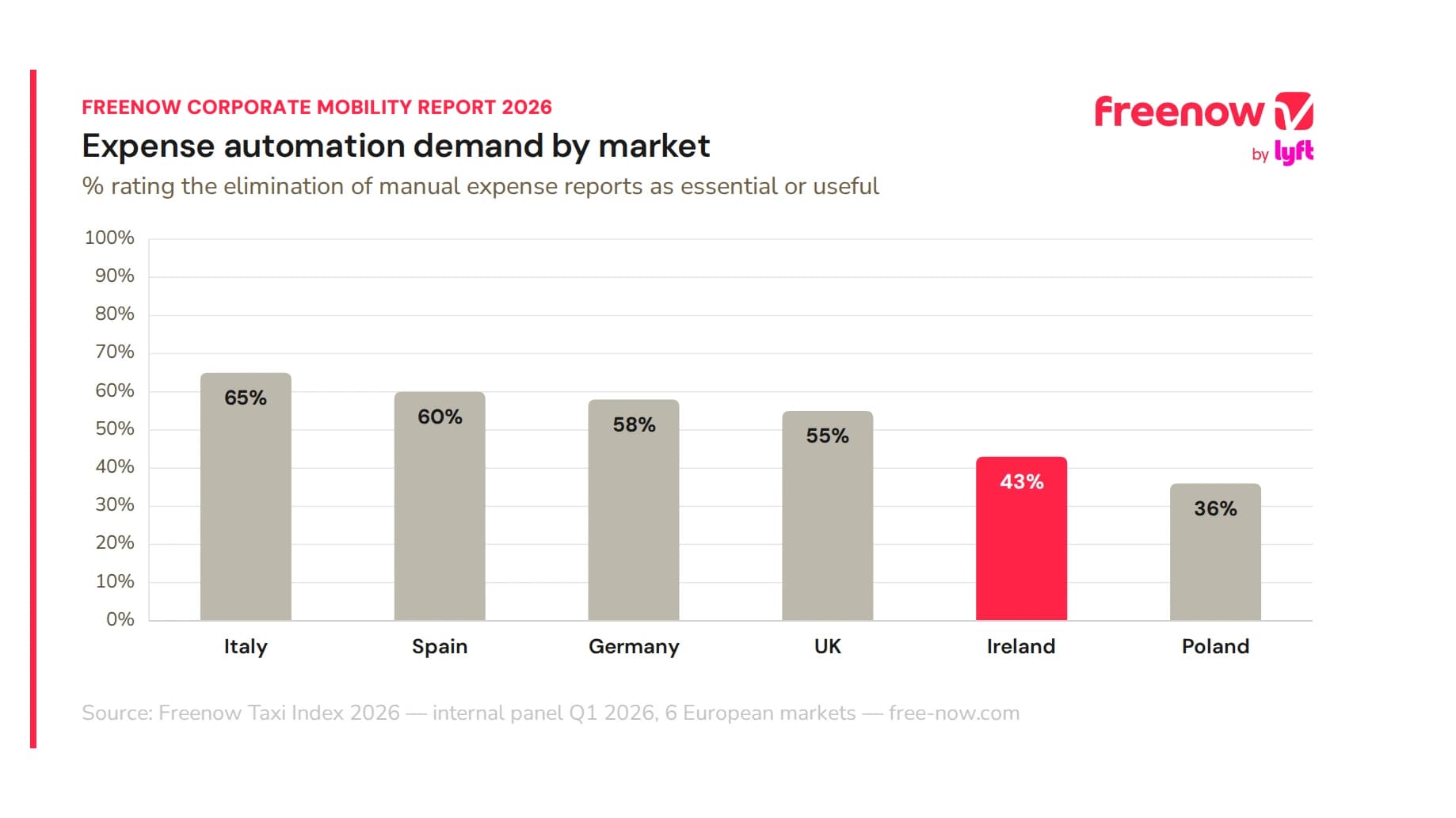
43% of Irish corporate travellers rate automated expense elimination as essential or useful (internal panel, Q1 2026), trailing high-demand markets such as Italy (65%) and Spain (60%).
28% of Irish professionals booked a journey for a colleague, client or guest via a corporate account during the preceding three months (Q1 2026), marking the second-lowest organiser share among surveyed markets.
2.0% of corporate rides in Cork connected directly to SAP Concur or Amadeus Cytric in FY 2025, recording the highest integration share among Irish urban centres.
Manual expensing remains an operational bottleneck across European corporate travel. Brand Tracker data indicates that between 43% and 48% of business travellers across Europe still settle trips with personal cards, manually claiming reimbursements later. This ghost rider pattern creates administrative friction, burdens finance teams and dilutes visibility over corporate ground transport.
In Ireland, demand for automated expensing exists but trails leading Southern European markets. In Q1 2026, 43% of Irish business travellers classified eliminating manual expense reporting as essential (12%) or useful (31%), trailing Italy (65%) and Spain (60%). With 57% viewing these tools as not important, Ireland offers substantial headroom to expand automated corporate workflows.
Centralised bookings for third parties also show significant scope for digitisation. In Q1 2026, 72% of Irish respondents never booked a trip for a colleague, client or guest on their corporate account in the preceding three months, leaving an active organiser base of 28%, the second-lowest among surveyed countries. To streamline these arrangements, Freenow offers the Web Booker, a desktop portal enabling receptionists and travel coordinators to arrange rides directly via a corporate account, removing personal out-of-pocket claims.
Transactional data from FY 2025 on ERP integration rates linking trips to SAP Concur or Amadeus Cytric
City | Concur/Cytric integration share |
Cork | 2.0% |
Limerick | 1.6% |
Dublin | 1.3% |
Galway | 0.7% |
Cork leads on integration share at 2.0%, narrowly ahead of Limerick and Dublin. Because Dublin commands the largest share of overall B2B ride volume, this comparison measures adoption intensity rather than total automated volume.
How sustainable is business travel with Freenow in Ireland?
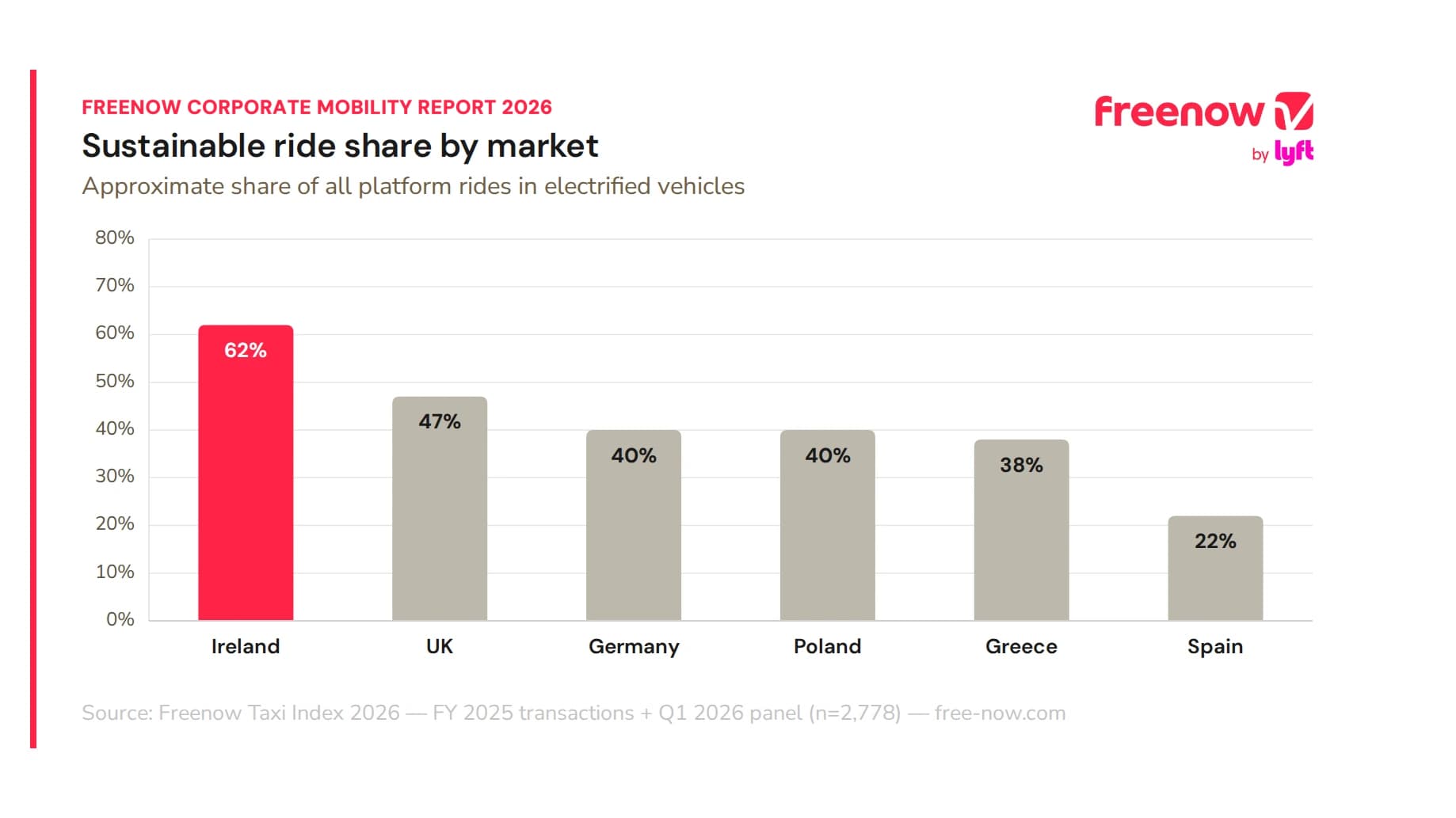
62% of all platform rides in Ireland are completed in electrified vehicles, establishing the highest overall electrification rate among all seven European markets analysed.
61% of corporate B2B rides on Freenow in Europe were electrified in FY 2025, outpacing the broader platform benchmark of 51% by ten percentage points.
55% of 1,725 drivers surveyed across seven European markets cite range anxiety as the principal barrier to adopting fully electric fleets.
Ireland records the highest platform-wide electrified ride share of any market in this report, with approximately 62% of all trips completed in electric or hybrid vehicles. This positions Ireland comfortably ahead of larger European markets such as the UK (around 47%), Germany (around 40%) and Spain (around 22%), establishing a distinctive operational baseline for sustainable business travel.
Corporate journeys specifically mirror this environmental momentum. In FY 2025, 61% of Freenow B2B trips in Europe were completed in electrified vehicles, outperforming the overall platform average of 51% by ten percentage points. However, this transition is currently driven by operational fleet availability rather than formal corporate mandates. Sustainable adoption is running ahead of corporate travel rules, giving Irish procurement leads an immediate opportunity to formalise green travel policies and report verified emissions reductions.
Platform investment continues to expand this low-emission capacity: in FY 2025, 69% of new vehicles onboarded were electrified, while 79% of shared mobility journeys ran on pure electric power. Further scaling requires targeted charging infrastructure, as 55% of 1,725 commercial drivers surveyed across seven markets identify range anxiety as their primary operational obstacle.
How does B2B vs B2C usage differ at Freenow in Ireland?
3.44 monthly rides are completed on average by B2B users compared to 2.73 by B2C riders in FY 2025. Corporate users also demonstrate a 33% higher loyalty rate driven by integrated billing tools.
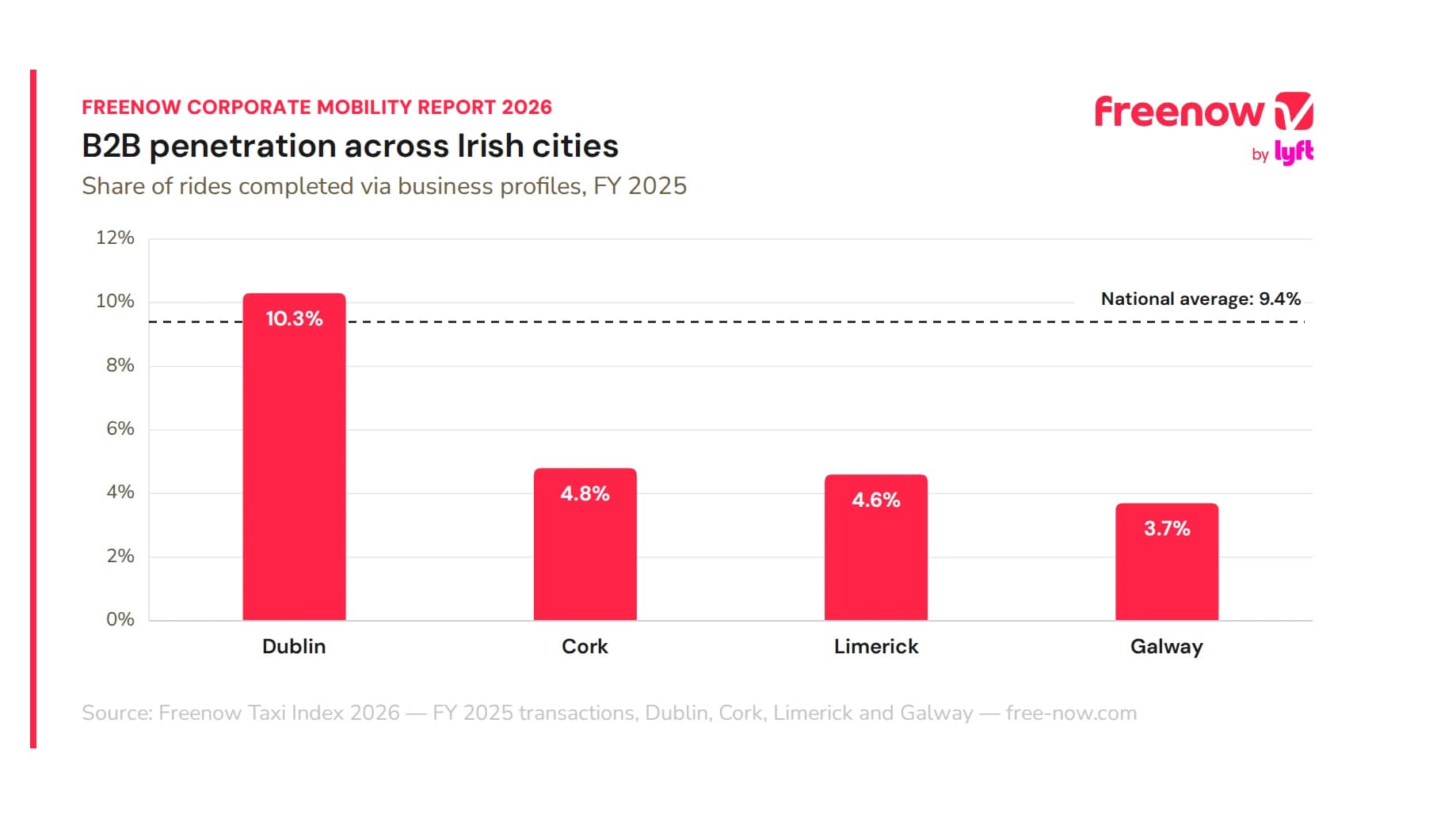
10.3% of all rides in Dublin are completed via corporate profiles in FY 2025, positioning the capital as Ireland's leading B2B mobility market ahead of the 9.4% national average.
5.17 rides per unique B2B rider each month are recorded in Dublin (FY 2025), establishing that the capital leads the country in both corporate profile share and usage frequency.
8.9% airport and 0.6% rail share characterise Dublin's transit trips in FY 2025, with low rail drop-offs reflecting direct rail-to-airport transit constraints rather than service coverage gaps.
Corporate travellers demonstrate higher usage intensity and retention compared to leisure passengers across every market studied. In FY 2025, B2B users completed an average of 3.44 rides per month compared to 2.73 rides for B2C users. This elevated engagement stems directly from the ongoing efficiency of centralised company billing and automated expensing tools that simplify recurrent business journeys.
Within Ireland, Dublin serves as the clear focal point for corporate ground mobility. In FY 2025, Dublin led the nation with a B2B profile share of 10.3%, comfortably exceeding the Irish national average of 9.4%. Unlike markets where volume penetration and ride frequency are split across different urban centres, Dublin leads on both key metrics simultaneously, recording 5.17 monthly rides per unique B2B rider. Regional centres demonstrate consistent business engagement, led by Limerick (4.85), Galway (4.68) and Cork (4.02).
Analysis of journeys connected to major transport hubs reveals distinct local travel patterns across the island. Dublin Airport represents 8.9% of all rides in the capital, the highest airport share nationwide, reflecting its position as Ireland's primary commercial gateway. Conversely, Dublin's train station share stands at an unusually low 0.6%, a pattern that reflects limited direct rail-to-airport connectivity across the city rather than an operational coverage shortfall. Outside Dublin, Cork exhibits the most balanced transit footprint in Ireland, maintaining a steady share of trips across both airport drop-offs (5.8%) and rail terminal connections (4.2%).
B2B profile share
City | B2B profile share |
Dublin | 10.3% |
Cork | 4.8% |
Limerick | 4.6% |
Galway | 3.7% |
Airport vs Train station share per city
City | Airport share | Train station share |
Dublin | 8.9% | 0.6% |
Cork | 5.8% | 4.2% |
Limerick | 0.8% | 4.3% |
Galway | 0.0% | 2.5% |
Methodology and data transparency
This report applies a three-tiered triangulation methodology designed to provide verifiable benchmarks for European urban mobility without relying on isolated sentiment or unverified estimates. The first tier uses an external Brand Tracker running as a rolling quarterly online panel from Q1 2025 through Q1 2026. This layer surveyed approximately 300 Irish participants each quarter, capturing baseline metrics across brand awareness, consideration and general payment preferences.
The second tier draws on an internal panel conducted in Q1 2026 via a five-question Qualtrics survey distributed through CRM channels to verified Freenow riders. This produced 351 verified responses focused specifically on the Dublin commercial hub, examining expensing practices, the organiser booking role, corporate sustainability rules and how business travellers define professional standards.
The third tier analyses operational transactional data covering the complete 2025 financial year. This operational cube filters for business and hybrid user activity across Dublin, Cork, Galway and Limerick, establishing grounded metrics for corporate profile share, multimodal transit connections and software integration rates. Reviewed and approved by Freenow's compliance and data protection teams, the dataset contains no personally identifiable information and presents findings strictly as aggregated city-level and national averages.
Talk to our team today
FAQs
What is the Freenow corporate mobility report for Ireland?
It is a 2026 data-led benchmark study analysing Irish B2B ground transport patterns. The research triangulates an external Brand Tracker, an internal panel of 351 verified responses and FY 2025 transactional trip data across Dublin, Cork, Galway and Limerick.
How do Irish business travellers view automated expense management?
Manual expensing remains an operational burden, with 43% of Irish business travellers rating automated expense elimination as essential or useful. While this trails higher-demand markets like Italy (65%) and Spain (60%), it indicates substantial headroom for corporate workflow automation.
Which Irish city records the highest level of business travel activity?
Dublin leads all Irish urban centres in corporate demand, recording both the highest B2B profile share and the highest monthly trip frequency among business riders. This dual lead establishes the capital as Ireland's primary commercial mobility hub.
What proportion of Freenow rides in Ireland are electrified?
Ireland records the highest platform-wide electrification share among all seven analysed markets, with roughly 62% of all trips completed in electric or hybrid vehicles. Furthermore, 61% of all Freenow's European B2B rides were electrified in FY 2025, outpacing the 51% platform average.
How does loyalty and usage frequency differ between corporate and leisure passengers?
Corporate travellers demonstrate a 33% loyalty premium over leisure passengers across the network. In terms of use, business users complete an average of 3.44 rides per month compared to 2.73 rides for B2C riders.